
Exploratory Papermaking
Seven years ago, a simple question "how is paper made?" - sent me down paths I didn't expect

As a visual artist and someone who has drawn since childhood, paper is integral to my life.
Hours and hours of my life have been spent doodling, sketching, and finessing lines on paper.
I was curious, how is paper made? Where does the pulp come from? Does it have to be bleached to make it white? Does it even need to be white at all? Is there a sustainable way to make paper?
I began hunting down any information I could find - I pored over blogs, and purchased Nick Neddo’s book “The Organic Artist: Make Your Own Paint, Paper, Pigments, Prints and More From Nature”. From the thrift store I purchased a cheap blender to break down paper pulp, and I made a makeshift screen from a picture frame and stapled mesh over it. Scavenging papers from the recycling bin, I soaked it in hot water and blitzed it up in my secondhand blender. To my pulp I added bits of local plant matter for texture and visual interest, and to shift the color of the paper, I used natural dyes from local butternut hulls, blueberries, and food waste like onion skins and coffee grounds. When creating the sheets of paper, it helps to make the water slightly viscous as it slows the water down and gives the pulp a bit more time to settle on the screen. For this I experimented with using the weed mallow, which has mucilaginous qualities, and worked quite well!
My process was exploratory, and the results were variable. Some papers stuck terribly to the screen, other times I wouldn’t have broken the pulp down enough so the paper was lumpy or holey. Overall I loved the textures and hues that came from incorporating plant matter and dyes, and the paper lent itself wonderfully to collages.
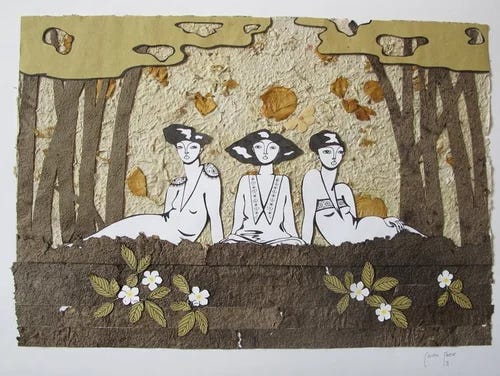
“Wild Strawberries” original artwork 2017 // illustrated collage with butternut hull paper (deep brown), and handmade paper with dried plant matter in background, made by my sister!
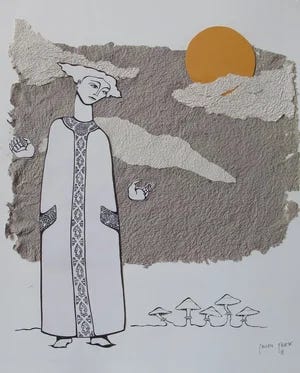
“Queendom” original artwork 2017 // illustrated collage with blueberry paper (bluey/gray backround paper), and undyed white recycled paper.
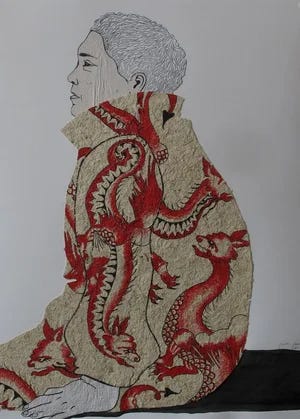
“Dragon Coat” original artwork 2017 // illustrated collage with birch bark paper.
As much as I loved my home-made paper, I wanted to know how to make it more suitable for drawing. I needed the paper to be stronger, less prone to holes and lumps.
I had heard that Japanese washi (paper) is known to be incredibly strong yet thin, and perfect for ink drawings. Intrigued, I decided to travel across the world to rural Japan to learn for myself how to make this exquisite paper.
Join me next week as I share my firsthand experiences in two rural Japanese papermaking workshops.